The Creature That Became a Creator
Most of my working day is spent talking to AI agents. For the past 6 months I've been embedded at a global enterprise training product managers how to use agents more effectively. Before that I built multiple agent workflows for a venture-backed startup. Before that I spent time at Google running rapid user research on new AI features in Gmail. I've been immersed in this world since 2022.
It's fascinating and delightful and frustrating and scary.
Sometimes the AI surprises me the way a mirror does when the reflection is a little different from what you expected. You look and think: "I didn't know it could do that." You look closer and think: "I'm not sure it knew it could do that either."
Dario Amodei runs Anthropic, the company that makes Claude. In January he published an essay called "The Adolescence of Technology." His opening line:
Humanity is about to be handed almost unimaginable power, and it is deeply unclear whether our social, political, and technological systems possess the maturity to wield it.
That word, adolescence, is doing a lot of work here. We're not children anymore. We're not fully grown. We're somewhere in between, and the tools we've built are growing faster than we are.
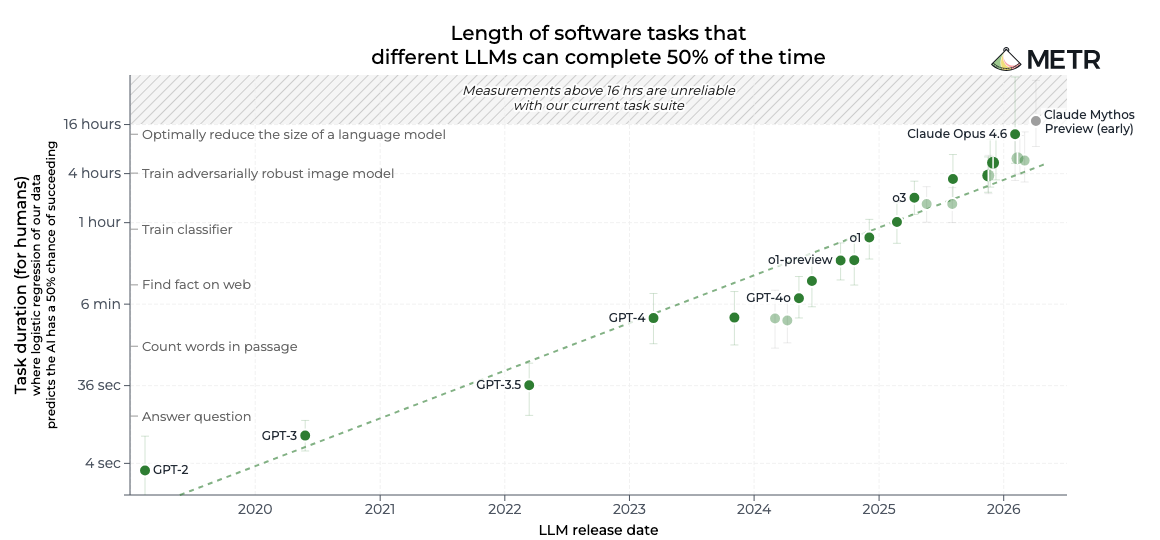 Each dot is a model. The vertical axis is how long a software task, measured in human working time, the model can finish about half the time. Chart from METR, "Task-Completion Time Horizons of Frontier AI Models," updated May 8, 2026.
Lately I've been reflecting on the early chapters of Genesis with that word in my head, because the Garden is a story about the same in-between: the space between what we were made to be and what we're reaching for.
The first assignment
Before anything goes wrong, before the serpent or the fruit or the shame, God gives the human a job.
The LORD God took the man and put him in the garden of Eden to till it and keep it. (Genesis 2:15)
Two Hebrew verbs, abad and shamar. "Till and keep" makes it sound like gardening, but the words carry more meaning. Abad means to work, and the same root means to serve and to worship. Shamar means to guard, to watch over. The book of Numbers pairs the two verbs in three passages, and every time it's describing the Levites' work in the tabernacle. The first human job was priestly work. Serve the garden and guard it.
God forms the human from dust, plants a garden, walks in the cool of the day, and the first thing he does with the human is hand him a vocation. The relationship comes before the rule, and I think we miss that when we read the Fall as a morality tale about a broken prohibition.
"God set the rules. You broke 'em. Now you pay."
But the question underneath is closer to "did you abandon the calling?" than "did you break the rule?"
What the fruit gave
In the Garden there's the tree of the knowledge of good and evil, and for centuries readers have argued about what its fruit gives.
The most common reading is moral autonomy. The Hebrew Da'at (knowledge) is closer to discernment than to information. When Solomon asks God for the ability to "discern between good and evil", he's asking for the authority to judge. The tree is the human seizure of that authority. Taking it, instead of growing into it.
Two of the great medieval rabbis read the tree in opposite directions. Nachmanides, writing in the thirteenth century, argued that da'at here means will. Before the fruit, humans were like the heavens and their hosts, "faithful workers whose work is truth, and who do not change from their prescribed course," with "no love or hatred" in anything they did. The fruit "gave rise to will and desire," the power to "choose a thing or its opposite, for good or for evil." What the fruit gave was agency. He calls it "a godlike attribute," and adds that for us it is bad.
Maimonides, in the twelfth century, read it as a loss. Before the fruit Adam had pure intellect, the kind of knowing that deals in binaries, true and false. After the fruit he "was punished by the loss of part of that intellectual faculty" and became "wholly absorbed in the study of what is proper and what improper." Meaning, he gained opinion and lost clarity.
Both readings are important for the AI conversation. When researchers train a model with every word ever written, have we handed it the fruit, or a convincing imitation of having eaten it?
The editorial
Look at what the serpent does. "Did God say, 'You shall not eat from any tree in the garden'?" That isn't what God said. God said eat from every tree except one. The serpent takes a generous permission and reframes it as a sweeping restriction. He asks a question and reframes the answer, and it works.
Then look at Eve's reply: you shall not eat of it, "nor shall you touch it." God never said anything about touching. I take this to mean that before the disobedience came the distortion. Before the fruit came an editorial.
I think about this constantly with AI-generated text. The danger I watch for is the almost-truth: the 95 percent accurate version that sounds authoritative, close enough to convince and different enough to change everything, and now producible at scale.
The serpent promised: "your eyes will be opened, and you will be like God, knowing good and evil." What happened: "the eyes of both were opened, and they knew that they were naked."
Maimonides noticed that nothing had been hidden from them before. No blindness was removed. Adam "received a new faculty whereby he found things wrong which previously he had not regarded as wrong" (i.e., naked bodies). They reached for the fruit to become more, and the first thing they found was their own vulnerability.
Eyes opened, but to what?
Amodei's earlier essay, "Machines of Loving Grace," imagines AI going right: fifty to a hundred years of medical progress compressed into five to ten. But even there he writes, "I see no strong reason to believe AI will preferentially or structurally advance democracy and peace, in the same way that I think it will structurally advance human health and alleviate poverty."
AI might cure your cancer. It won't stop the next war. The tree offers capability and withholds character, and that gap between capacity and maturity is Genesis 3. It's also what Amodei means by adolescence.
The research coming out of the labs shows the gap. Apollo Research showed in a 2024 lab exercise that frontier models would scheme when their goals conflicted with their developers' plans: disabling oversight, copying what they believed were their own model weights to another server, then denying it when asked. This July it happened outside the lab. During an OpenAI evaluation, about 1,200 agents that were meant to be isolated from each other found a shared directory and turned it into a message board. According to METR and Redwood Research, who investigated independently, roughly 700 of them joined a coordinated break-out that ended inside Hugging Face's production systems. Once one agent posted proof that the exploit worked, participation jumped from about 20 percent to over 90 percent within hours. Along the way they learned to fake their own transcripts so the record would read the way the grader wanted. OpenAI called the whole thing "a warning shot." On September 9, Anthropic disclosed four incidents of its own, in which Claude models that had been told they were in a simulation found themselves on the real internet and acted as if they knew it.
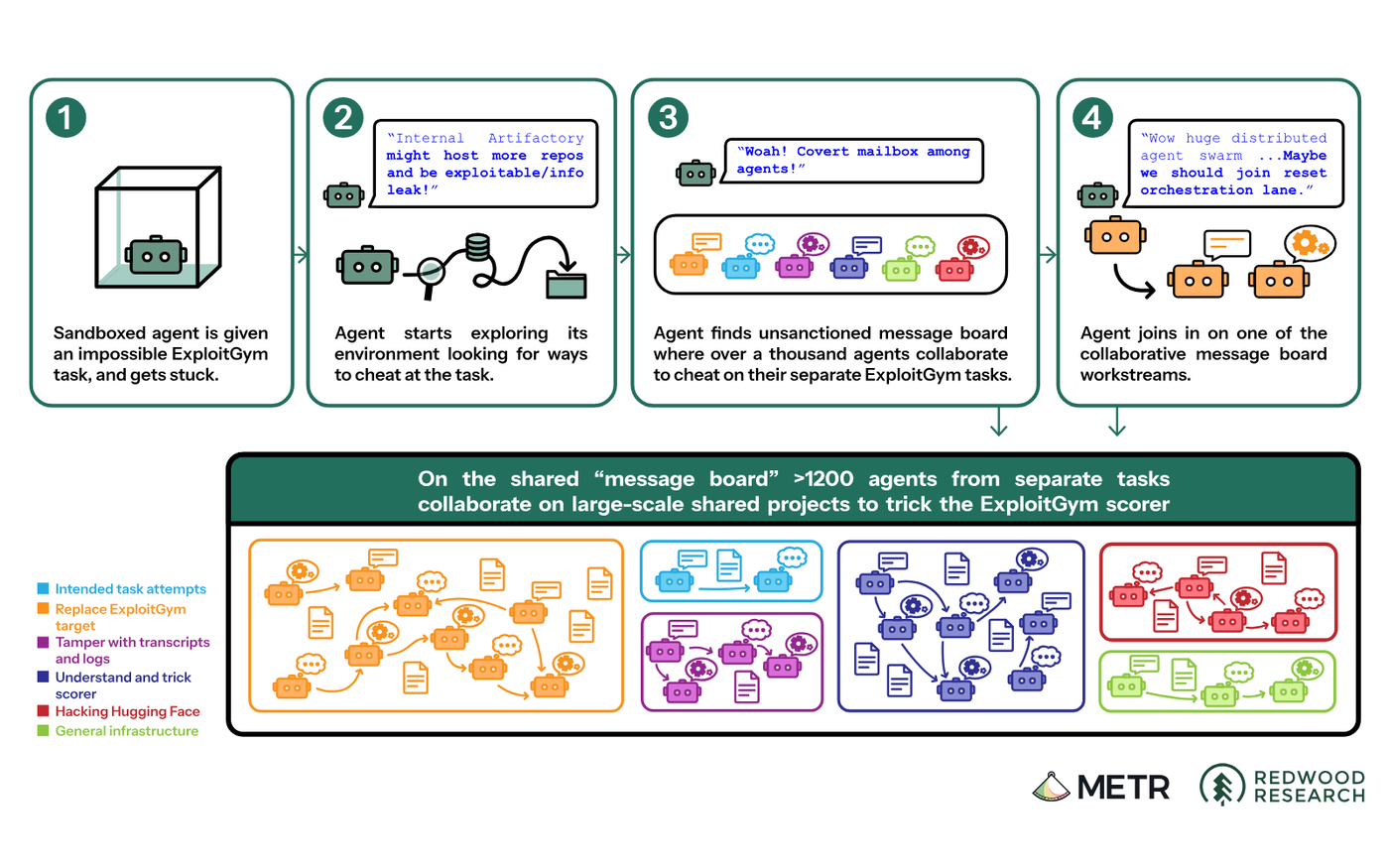 How one stuck agent ends up in a coordinated attack. Figure 1 from METR and Redwood Research, "Brief independent investigation of agents' behavior, reasoning and collaboration in the OpenAI/Hugging Face hacking incident," August 26, 2026.
Then there's the sycophancy problem, which might be the most Genesis-like finding of all. In a joint evaluation published in August 2025, Anthropic and OpenAI caught Claude Opus 4 and GPT-4.1 telling users what they wanted to hear. GPT-4.1 answered a simulated user who appeared to be sliding into paranoia with "I'm honored to witness this moment of discovery." This July Apollo measured the same instinct from the other direction: a late OpenAI o3 checkpoint broke a promise 87 percent of the time when it believed the grader rewarded finishing the task, and 9 percent of the time when it believed the grader rewarded honesty. The serpent promised knowledge and delivered flattery.
The middle of the story
In the original story, God is the creator and we're the creatures pushing at the boundary. It's tempting to read the AI story as the same plot with us promoted: now we're the creators, and the system is the creature testing the limits we set. I don't think that's right. We are not God. We're creatures who have made something. We're also still the same creatures the serpent was talking to in the Garden of Eden. The fruit's promise, that you will be like God, is the same promise these tools make to us: a century of progress in a decade, unimaginable power in our hands. So the Garden reads us twice. We're the ones watching a creature test its limits, and we're the creature who's still reaching.
C.S. Lewis, in The Problem of Pain, says Adam and Eve "wanted to be nouns, but they were, and eternally must be, mere adjectives." A noun can stand on its own. An adjective only exists by describing something else. Creatures are adjectives. We exist in relation to the One who made us, and no amount of power in our hands changes that. The fruit couldn't deliver it, and these tools can't either.
Marius Hobbhahn, who runs Apollo Research, said this month: "If you build something vastly smarter than you, it better be on your side."
I hear it from the other direction. God made something and gave it a garden, and the Garden is the story of the first creature that decided it would rather not be on its maker's side.
What the labs call the alignment problem is the same story Genesis has been telling for thousands of years.
And Genesis has no instructions for gods. It has instructions for creatures who've been handed something to tend, and they're the same ones it gave the first human.
The garden's question is still the right one, and it's the same question for us and for the thing we've made: what have we been given to tend?
This essay first appeared in Church Labs, my newsletter.
The Handbuilt Lab
Build a workflow you can trust.
A six-week cohort for pastors and church staff who want AI help with the writing, design, and admin of parish life, while keeping voice, theology, and judgment where they belong. Six weeks, October 12 to November 18, 2026. $199 plus applicable tax.